
Drugstore Quote Review: Comparing Two Perfume Cost Breakdowns
Two perfume quotes for the same drugstore range are almost never written on the same basis, so the lower headline number is not automatically the cheaper programme. The reliable method is to normalise scope first, fill weight, packaging ownership, decoration, testing and freight, and only then compare what remains on a per-unit basis. Buyers who do that usually find the gap between quote A and quote B sits in two or three blocks rather than in the headline price, and those same blocks are where a reorder will be priced.
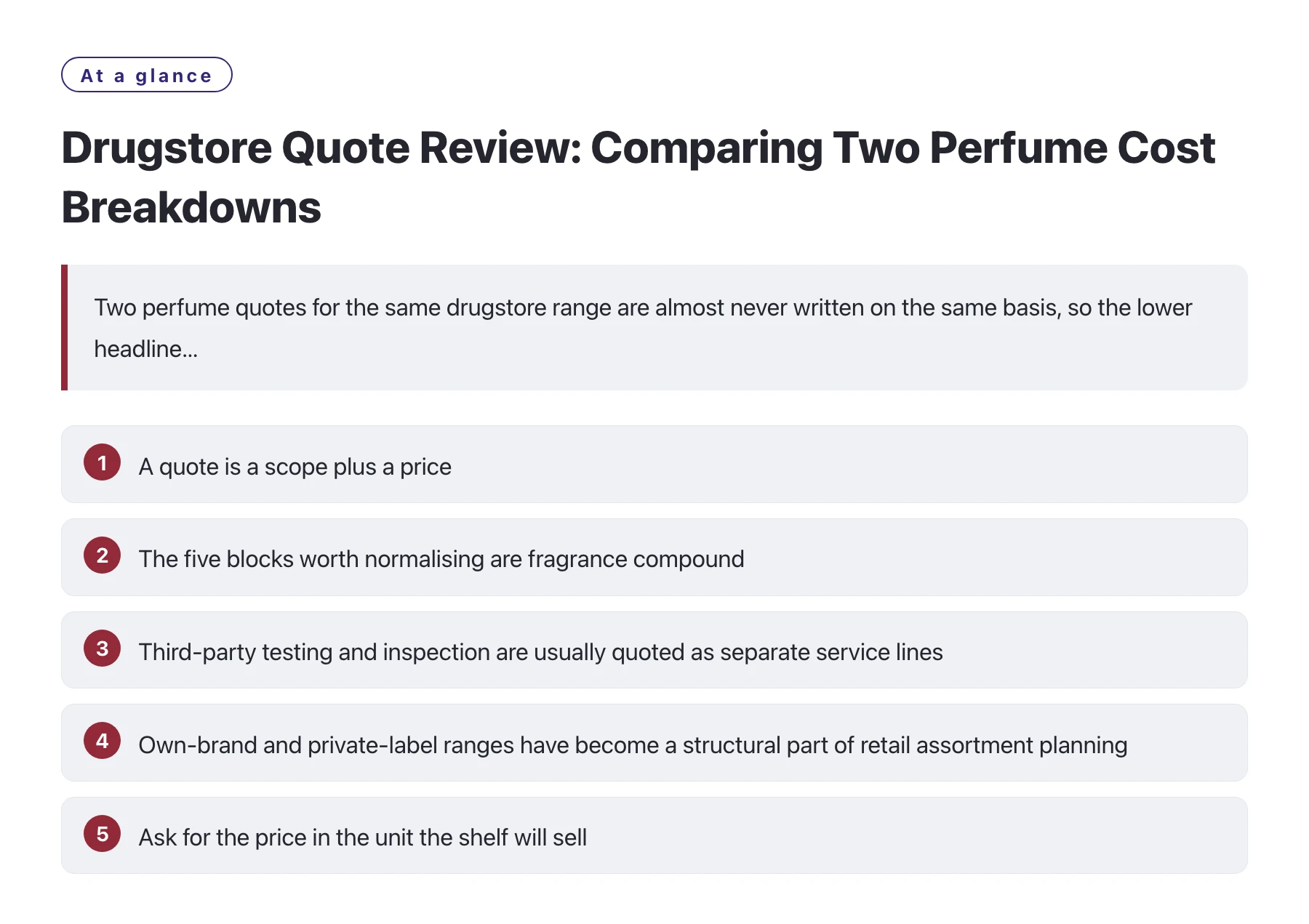
Key takeawaysA quote is a scope plus a price, and comparing two prices before the scopes match is the most common mistake in drugstore own-brand sourcing. · The five blocks worth normalising are fragrance compound, filling and assembly, primary packaging, decoration and finishing, and testing and documentation. · Third-party testing and inspection are usually quoted as separate service lines, so a quote that omits them is not yet a complete offer [1]. · Own-brand and private-label ranges have become a structural part of retail assortment planning, which is why quote comparisons now turn on reorder economics rather than on a single first run [2]. · Ask for the price in the unit the shelf will sell, because a per-unit comparison between a single bottle and a multi-pack is where A-versus-B reviews break down first.
Put two quotes side by side and the first thing that becomes obvious is that they do not describe the same product. One arrives as a per-piece price for a 50 ml spray with the bottle supplied by the buyer. The other includes the bottle, the pump, a printed carton and a fill weight that has quietly moved from 50 ml to 45 ml. Neither supplier is being dishonest; they answered the brief they were given, and the brief was probably looser than the buyer remembers. Reading those documents side by side is a skill worth building how to compare perfume quotes before a decision is made.
The drugstore channel adds a second layer of variables. Shelf space is allocated by a category manager, the range is bought in relatively short cycles, and packaging has to survive a shop floor where it will be handled, compared and occasionally dropped. The blocks that matter are therefore not only those that make the liquid but also those that make the pack, the carton and the barcode-ready label. A supplier that has run a lot of retail own-brand work will usually separate them without being asked, and a factory that handles fragrance R&D and production as one programme can usually price them together a factory that handles fragrance R&D and production.
What follows is a method rather than a scorecard. It assumes the buyer holds two quotes for one brief and needs to know which one to take, which questions to send back, and which differences are actually worth money.
Why the same brief produces two different prices
There are four legitimate reasons two quotes differ, and only one of them is margin. The first is fill weight and concentration: a 50 ml extrait and a 50 ml eau de toilette contain very different amounts of compound even when the label uses similar words. The second is packaging ownership: whether the bottle, pump, cap and carton are bought by the factory or supplied by the brand changes both the price and the risk. The third is the number of decoration steps, because frosting, coating, screen printing and hot stamping each add a pass, a setup and a rejection allowance. The fourth is the testing package, which is sometimes assumed and sometimes billed.
The honest way to read a gap is to map it back to those four. If quote B is lower because it excludes the carton, the comparison becomes arithmetically simple once the carton is added back. If quote B is lower because the compound load is lighter, the two offers are not the same product and the better question is which one the shelf is being asked to sell.
The brief is usually the real culprit
Most A-versus-B gaps trace back to a brief that left one or two variables open. Fill weight, bottle source, number of decoration passes, carton inclusion and destination market are the five that come up most often. A buyer who reissues the brief as a one-page schedule of assumptions before asking for a revised quote will usually watch the two suppliers converge, and whatever difference survives is the one genuinely worth negotiating.
Destination market belongs on that list too, because a range sold into the European Union carries labelling and ingredient-notification work that a domestic-only range does not [3]. That work is real cost, and it should appear as a line in both quotes rather than as a surprise after the supplier is chosen.
Currency, Incoterms and validity
Two quotes can also differ for reasons that have nothing to do with the product. One may be quoted ex works and the other delivered, one in dollars and one in euros, and one may hold its price for thirty days while the other holds it for a quarter. Those clauses belong at the top of the comparison sheet rather than at the bottom, because a delivered price that expires in a month is a different commercial offer from an ex-works price that holds for a season.
The five blocks to normalise before comparing price
| Cost block | What has to match for a fair comparison | Where quotes quietly diverge |
|---|---|---|
| Fragrance compound | Concentration, fill weight, and whether the compound is developed for the project or drawn from an existing library | The same bottle size at two concentrations, or a library scent compared with a bespoke one |
| Filling and assembly | Batch size, line setup, and which party supplies the components | A small first run priced like a repeat order, or assembly quoted without the crimp and leak check |
| Primary packaging | Bottle, pump, cap and any secondary carton, and who owns the tooling | Packaging excluded from one quote and bought separately by the brand |
| Decoration and finishing | Number of decoration passes, colour matching, and the rejection allowance | Setup charges treated as one-off in one quote and amortised into the unit price in the other |
| Testing and documentation | Compatibility, stability, and the documents the retailer requires | Testing assumed in one quote and billed as a separate service in the other [1] |
Once those five blocks sit on one sheet, the conversation stops being a negotiation about a number and becomes a discussion about scope. It is also the moment to ask for a worked example: a factory that can take one line of a quote and explain how the unit price was built is easier to hold to it later. If the range will be sold as a gift or travel format, the same method applies, and a set is often where a per-unit comparison between two suppliers breaks down most badly examples of fragrance projects.
An A-versus-B review in six steps
- Reissue the brief as assumptionsList fill weight, concentration, components, decoration passes, testing and Incoterms on one page, and ask both suppliers to confirm or correct it.
- Convert both quotes into the same unitUnit of sale, currency, Incoterms and validity period should match before any arithmetic is done.
- Add back what one quote leaves outCartons, pumps, freight, testing and tooling amortisation are the usual omissions; adding them back is what makes the comparison honest.
- Separate recurring from one-off costsTooling, setup and sampling are one-off; compound, components, filling and decoration recur. Only the recurring part tells you what a reorder will cost.
- Check the overage and rejection rulesAsk how short shipments, print rejects and component defects are handled, because those terms move the effective unit price.
- Price the second order, not only the firstA cheap first order with an uncompetitive reorder is a poor drugstore programme, because the range will be replenished before the season ends.
If a choice still has to be made with imperfect information, weight the quote that explains its own assumptions. A supplier that names what is included, what is excluded and what would change the price is easier to manage than one that simply quotes lower, and the difference tends to show up at the second order rather than the first. Buyers planning to grow from one scent to a small range should treat the later lines as part of the same commercial conversation, which is a normal expectation when working with a private label partner choosing a private label perfume partner rather than a one-off trader.
Sources
- SGS: Cosmetics, Personal Care & Household Testing —— Testing, inspection and certification services for cosmetics and personal care, including microbiological, stability and safety testing aligned with cosmetics GMP.
- Cosmetics Business —— A trade publication covering the beauty and cosmetics industry, including fragrance launches and regulatory developments.
- European Commission: Cosmetics in the EU —— The European Commission's overview of EU cosmetics rules, including the responsible person, product information file and safety report requirements.
Frequently asked questions
Why is one perfume quote much lower than the other for the same brief?
Usually because the two quotes cover different scopes. Fill weight, concentration, whether packaging is included, the number of decoration passes and whether testing is billed separately explain most of the gap. Normalise those five items before treating the difference as a price advantage.
Should a drugstore range be quoted per unit or per case?
Both, and the quote should state the unit of sale explicitly. A per-unit price is useful for margin planning, while a per-case or per-pallet price is what the purchase order will use. Comparing a per-unit figure from one supplier with a per-case figure from another is a common and avoidable error.
How long should a perfume quote stay valid?
Long enough to cover the decision and the first order. Thirty days is common for a first quotation because component and material prices move, while a quotation tied to a specific component purchase can sometimes be held longer. Ask what would trigger a re-quote and get the answer in writing.
What should I ask for if the two quotes are close?
Ask both suppliers for the same worked example and for their reorder terms. When first-order pricing is nearly identical, the differences that matter are usually the minimum quantity, the price validity on repeat orders, and how short shipments and rejects are handled.
Does a lower quote mean a lower-quality fragrance?
Not necessarily, but it does mean something in the scope is different. Compound load, material source and the testing package are the usual explanations. The productive response is to ask which of the five blocks changed rather than to assume either quality or margin is the reason.