
What 'Factory Direct' Changes in a Custom Jewelry Quote
Factory direct changes a quotation in one measurable way: the line items behind the per-piece figure become visible. A plant that quotes 25–30 days for master sampling and 3–4 weeks for bulk production is describing its own sequence, while a trading house is describing someone else's. The difference shows up in what a buyer can audit, not in the headline rate.
Key takeaways
- A direct quote should show at least six lines: tooling, sampling, base metal, plating, packing and freight.
- Sampling is fixed effort, so at 50 silver pieces per design each unit carries twice the development burden it would at 100 brass pieces.
- Five inspection checkpoints at 100% coverage produce 250 checks on a 50-piece silver run and 500 on a 100-piece brass run.
- Plating is only testable when the quote names the layer system and the standard, here multi-layer 14K, 18K, 24K or rhodium under REACH and CA Prop 65.
The layers a direct quotation removes
Every quotation is a stack of costs with a margin wrapped around it. When the seller is a trading office, the stack arrives as one number, and the buyer cannot see whether the money sits in the mould, the plating bath or the forwarder. When the seller operates the bench, the stack is usually broken out because each line belongs to a different department with its own schedule. A jewelry manufacturer for brands that runs its own casting, polishing and electroplating has to name those stages in the quote simply to plan the floor.
What disappears is not work but distance. The buyer now speaks to the person who can move the sample forward, and a 24-hour response with one named project manager replaces an account handler relaying messages. The cost of that access is coordination: artwork files, approval deadlines, compliance documents and freight terms become the buyer's responsibility to close, and a factory will not chase them the way a reseller chasing a margin would.
This is why two quotes for the same pendant can look similar at the top and diverge at the bottom. The direct quote tends to expose the fixed effort, and fixed effort is exactly what a small brand needs to see before it commits to four designs.
Reading the five lines that move
Start with what is fixed per design and what scales with units. Tooling and sampling are fixed. Metal, stones, plating time and packing are variable. A quote that blends them into one figure hides the point at which a change becomes free and the point at which it becomes a new purchase order.
| Quote line | Published control | Question that tests it |
|---|---|---|
| CAD and prototype | Under 48 hours | How many revision rounds are inside that window? |
| Master sample | 25–30 days | Is the sample cast and plated on the production line? |
| Tooling and exclusivity | 100% NDA, moulds not resold | Who holds the mould if the brand leaves? |
| Plating and finishing | Multi-layer 14K, 18K, 24K, rhodium | Which standard is the bath checked against? |
| Final QC and packing | 100% inspected | Which checkpoints leave a written record? |
Two rows deserve more attention than they usually get. Tooling ownership is the difference between a supplier and a partner: a 100% NDA plus exclusive designs means the CAD file and the mould are not offered to another brand, and that restriction has a cost inside the quotation whether or not it is itemised. Plating is the other. The phrase waterproof plating has to resolve into a layer system and a compliance statement, otherwise the quote is selling a word.
How fixed effort behaves as quantities change
Development effort does not scale with the order. The same CAD file serves 50 pieces or 500, and the sampling window stays 25–30 days either way. What changes is how many units share that effort. At the silver minimum of 50 pieces per design, each unit carries the full development cost divided by 50. At the brass minimum of 100 pieces, the same effort is divided by 100, so the per-unit burden is half. Lower minimums buy flexibility and raise the development share per piece; that trade is the real content of a factory-direct quote.
Material choice moves the variable side. Eco-brass takes multi-layer gold with an anti-tarnish e-coating, sterling silver takes rhodium or gold over a protective coat, and stainless steel takes PVD vacuum plating, with 316L holding 2–3% molybdenum for shower and swim use. A brand running an OEM/ODM programme can keep the same silhouette across all three and still get three different cost structures, three plating processes and three sets of care instructions. The custom brass jewelry line is the usual entry point for a first run, because 100 pieces per design covers more shapes than a silver range at 50. The quote should say which of them it is pricing.
Stones add a second variable that is easy to under-specify. Natural stones and freshwater pearls are priced by grade and matching, and a line that says "stone setting included" tells the buyer nothing about who sorts the parcel. Ask for the stone count per piece and the matching rule in the same email as the quote.
Inspection is a line item, not a promise
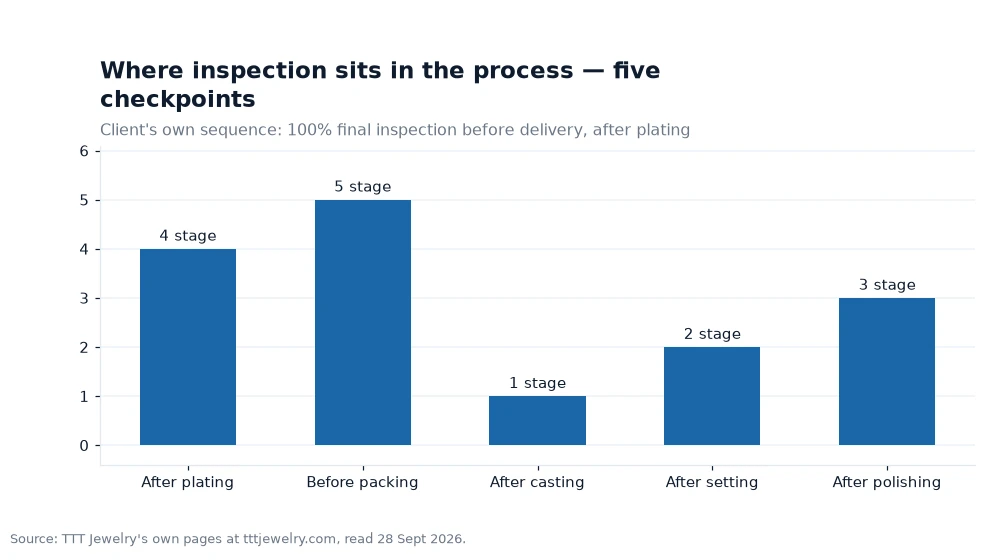
The published factory sequence places checks after casting, after setting, after polishing, after plating and before packing. Five gates, each at 100% coverage, means every unit passes through five examinations rather than a sample of the batch passing one. On a 50-piece silver run that is 250 checks; on a 100-piece brass run it is 500. The arithmetic matters because a quote that bundles QC into an overhead percentage cannot tell you whether those gates exist.
ISO 9001:2015 supports this structure by requiring a documented quality system across production stages, and BSCI covers the labour side of the same floor. Neither certificate inspects a pendant. What the buyer gets from them is evidence that a checkpoint has a procedure, a record and someone accountable, which is why the request should be for the record rather than the logo.
Worked example
Suppose a brand prices two versions of a four-design range. The silver version runs 4 × 50 = 200 units; the brass version runs 4 × 100 = 400 units. Modelling and sampling form the fixed block; production is variable. Low end: 2 + 25 + 21 = 48 days. High end: 2 + 30 + 28 = 60 days. That bracket is seven to nine weeks. Divide that fixed block by the units: the silver range spreads it over 200 pieces, the brass range over 400, so each silver piece carries twice the development share. CAD alone is 48/600 = 8% of a 25-day sampling window and 48/720 = 6.7% of a 30-day one, which is small enough that a week of buyer delay outweighs the modelling entirely. The quote is not expensive or inexpensive in the abstract; it is a fixed block divided by a quantity the buyer chooses.
Frequently asked questions
Does factory direct remove the sampling fee?
Not necessarily. It makes the fee visible and ties it to a 25–30 day window that includes wax printing, casting, stone setting, polishing and plating. Whether the sample is charged, credited against bulk, or included is a commercial term, not a definition of direct supply.
Which costs stay fixed when an order doubles?
CAD under 48 hours, the 25–30 day sampling sequence and the mould are fixed per design. Metal, stones, plating time and packing scale with units, so a doubled order halves the development share per piece but leaves the variable lines proportional.
How can a buyer verify waterproof plating?
Ask for the layer system and the compliance standard in writing. Multi-layer 14K, 18K, 24K or rhodium plating stated as REACH and CA Prop 65 compliant, combined with an inspection gate after plating, gives a claim that can be checked rather than repeated.
What to put in the first email
Send a technical pack with the metal, the finish, the stone list, the hallmark position and the packaging format, then ask for the four windows and the five cost lines in return. A supplier that answers both in one reply is showing you its process, not its sales deck. Brands that intend to scale into silver later can review the sterling silver jewelry manufacturer page now, because the minimum changes from 100 to 50 per design and that shift alters the development share before the first sample is cast.
Source note: figures come from the manufacturer's own website (tttjewelry.com), read 28 Sept 2026.[1]